Space Data Centers Are Moving Closer to Reality: Space Data Centers and the Rise of Optical Communication Infrastructure

Optical communication is becoming the foundation of the space computing era
Global computing demand is entering an exponential growth phase. Traditional terrestrial data centers are increasingly constrained by physical and energy limits: rising electricity costs, thermal management challenges, land availability, and the ultra-low latency requirements of AI workloads.
These pressures are driving a search for new infrastructure architectures. One concept that is rapidly transitioning from theory to engineering validation is the space data center and the broader space-based computing network.
Compared with ground-based facilities, orbital computing nodes could offer global coverage, direct long-distance connectivity, and inherent physical isolation. However, the viability of space computing depends on one critical prerequisite: stable, high-speed, scalable optical communication in space.
The U.S. and China Are Accelerating Space Communication Infrastructure
In the United States, the development of space data center capabilities is advancing along multiple parallel tracks.
Government agencies such as NASA and DARPA, together with commercial space companies, are continuing to invest heavily in laser inter-satellite links (ISL). Compared with traditional RF communication, optical links provide significantly higher bandwidth, stronger resistance to interference, and improved power efficiency—making them essential for future high-capacity satellite networks.
At the same time, major cloud providers including Microsoft and Amazon are exploring how computing infrastructure might extend beyond the ground. Advances in hollow-core fiber (HCF) technology, including work associated with Microsoft-backed research teams, are widely viewed as a key enabling technology for future ground-space-space optical communication architectures.
The overall direction is clear:
first establish high-capacity optical links in orbit, then gradually move computing resources closer to space-based networks.
In China, space data center concepts are being integrated into broader satellite internet and next-generation information infrastructure plans. Recent developments include continued investment in low-Earth-orbit constellations, integrated space-ground networks, and laser communication terminals.
Current public research indicates parallel progress in:
- ground-to-satellite optical links
- inter-satellite laser communication networks
- in-orbit information processing and computing validation
While the U.S. approach is more commercially driven, China’s strategy emphasizes system-level stability and long-term operational reliability. Both paths place extremely high demands on optical communication hardware performance.
Laser Communication Is Becoming the Backbone of Space Networks
Future space computing networks will rely heavily on optical communication rather than traditional microwave links.
Laser communication offers several critical advantages:
- higher data security
- lower latency
- greater bandwidth scalability
- improved spectral efficiency
As data rates move toward the Tbps range, the physical limits of optical links themselves become key system bottlenecks. This is driving innovation not only in terminals and modulation formats, but also in fiber and amplifier technologies.
Hollow-Core Fiber: Unlocking New Physical Limits
Hollow-core fiber has re-emerged as a promising technology in response to the needs of high-capacity optical communication.
Unlike conventional silica fiber, HCF guides light primarily through air, delivering several advantages:
- lower propagation latency
- significantly reduced nonlinear effects
- potential for improved radiation tolerance
- suitability for high-power transmission testing
Recent experimental results from Microsoft-supported research teams report transmission losses approaching or below 0.1 dB/km, indicating that hollow-core fiber is transitioning from laboratory research toward system-level validation.
However, material breakthroughs alone do not make a communication system deployable.
The gap between laboratory performance and operational readiness is defined by engineering capability—particularly in optical sources and amplification.
High-Power Optical Amplification: A System-Level Enabler

In real-world testing and deployment scenarios, optical communication systems must address:
- high path loss
- multi-wavelength transmission
- long-duration continuous operation
- temperature and power stability
As a result, optical amplifiers are no longer simply loss-compensation components.
They are becoming critical infrastructure for system reliability and validation.
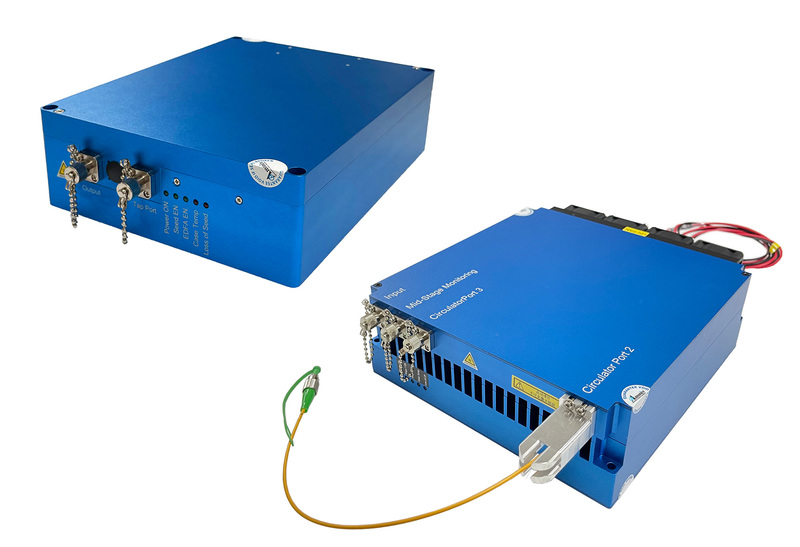
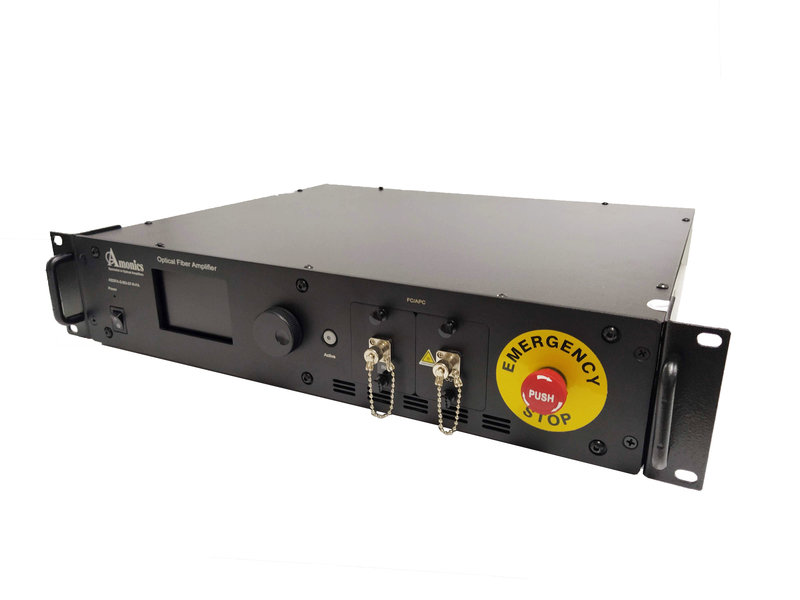
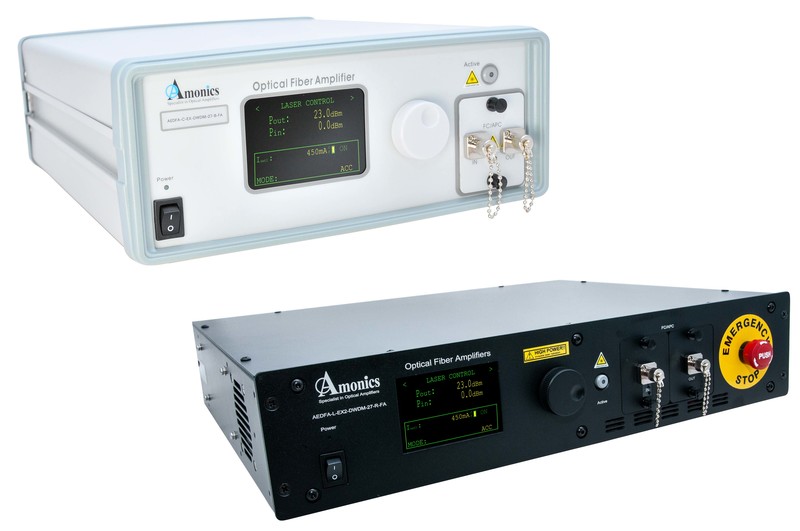
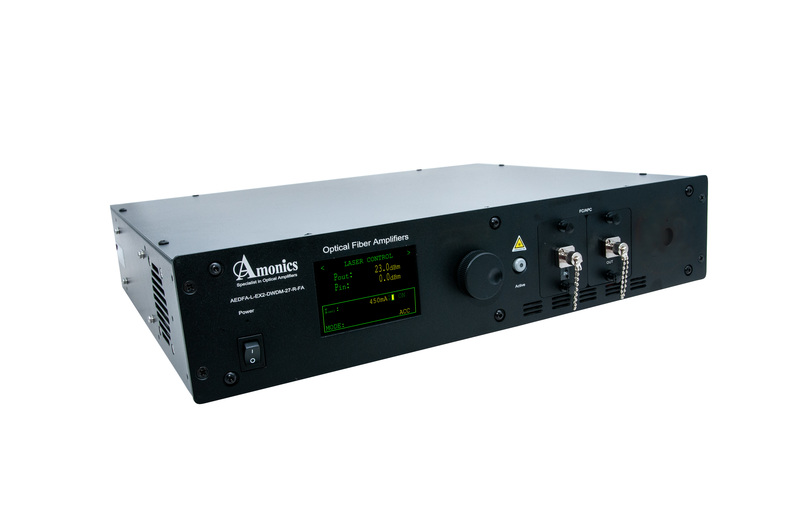
Stable high-power EDFA platforms are increasingly used to simulate realistic link conditions in:
- ground-to-satellite optical communication
- inter-satellite optical links
- hollow-core fiber testing
- high-capacity optical transmission experiments

The power stability curve of a 30-W-class high-power EDFA under continuous-wave operation demonstrates how consistent output performance supports link budget stability and long-term system evaluation. For applications such as space optical communication and HCF experiments, stable optical power over time is often more important than peak output levels.

Ground-to-Satellite Links: Power Stability Is Critical
In ground-to-space optical links, transmission budgets are extremely demanding.
Atmospheric turbulence, pointing errors, and long propagation distances require significant power margins.
Engineering priorities typically include:
- stable CW output power
- consistent multi-wavelength performance
- minimal power drift over long operation periods
Inter-Satellite Links: Reliability Over Peak Output
For satellite-to-satellite communication, long-term reliability is often more important than maximum output power.
Key requirements include:
- continuous operation
- stable wavelength and power
- low noise
- environmental robustness
In this context, optical amplifiers function as stable optical source platforms that support modulation formats and long-duration link operation.
From Ground to Space: A Converging Engineering Logic
A clear trend is emerging:
ground-to-space and space-to-space optical communication systems are converging toward a common engineering framework.
Hollow-core fiber, high-power optical amplification, and stable multi-wavelength transmission are shared foundational technologies enabling realistic testing and faster transition from laboratory to deployment.
The Growth Window for Space Optical Communication
From the concept of space data centers to the rapid deployment of laser inter-satellite links and continuing advances in fiber technology, the signal is clear:
A new growth cycle for optical communication is emerging, driven increasingly by space applications.
Over the next five years, new demand is expected to come from:
- space optical communication networks
- satellite constellations
- ground-space optical links
- AI-driven data infrastructure
- high-capacity optical testing environments
Meeting these needs requires:
- stable high-power amplification
- multi-band and multi-wavelength support
- system-level engineering reliability
This is not just an opportunity for a single product category.
It represents a broader evolution in the photonics industry as optical communication expands beyond terrestrial networks into space-based infrastructure.
As optical communication moves from ground networks into space-based systems, stable high-power amplification platforms will continue to play an important role in system validation and deployment.
Amonics Global Support:
Our high-power amplification solutions are deployed in leading photonics labs across North America, Europe, Asia-Pacific, and the Middle East. We provide specialized technical consulting for ground-to-satellite link budgets worldwide.
To learn more about high-power EDFA platforms for space optical communication and hollow-core fiber testing, contact us: contact@amonics.com or visit our product and technology pages