High-Power EDFA: The Backbone Technology for Space Optical Links and Hollow-Core Fiber Experiments
Introduction: A Shift Toward High-Power Optical Infrastructure
The last few years have seen major breakthroughs in optical communications—so significant that they are reshaping how future networks will be built. As AI workloads surge and global data demand grows, traditional C/L-band fibers are no longer enough.
Two technological fronts are accelerating fastest:
- Laser-based space communication (Space Optical Links)
- Next-generation hollow-core fiber (HCF) with ultra-low latency and record-low loss
Both trends have one thing in common:
They depend on reliable, stable, high-power optical amplification.
For these emerging systems, a standard telecom EDFA is no longer sufficient. Researchers require multi-watt saturated output, low noise, and stable long-term operation—conditions under which High-Power EDFA (HP-EDFA) becomes a critical enabler.
This article summarizes the latest industry data, explains why high-power amplification matters, and outlines how HP-EDFA is being used today for HCF experiments and space laser communications.
1. Space Data Centers and Space Optical Links: A Real Market, Not Sci-Fi
According to Euroconsult (2024) and NSR’s Optical Satellite Communications report (2025), the market for laser inter-satellite links (ISLs) is growing rapidly.
Key drivers:
- Rising demand for low-latency global coverage
- AI workloads pushing for reduced intercontinental latency
- Lower power consumption compared to RF systems
- Higher bandwidth and stronger security from coherent laser links
Modern LEO and MEO satellites now rely heavily on high-power optical transmitters, which require:
- Watt-level EDFA boosters
- Low-noise pre-amplifiers
- Stable gain across temperature and radiation-exposed environments
This is exactly the performance range covered by High-Power EDFA technologies used in today's optical terminals.
2. Hollow-Core Fiber: Loss Drops to 0.09 dB/km, Beating Silica Fiber Limits
In 2024, Microsoft/Lumenisity published new results in Nature Communications showing hollow-core fiber (HCF) reaching 0.091 dB/km loss, surpassing the ~0.14 dB/km theoretical limit of silica fiber.
Why this matters:
- Light travels ~30% faster inside air than in glass
- Lower latency is critical for HPC, AI, and financial networks
- Low nonlinearity enables higher power transmission
- Radiation resistance supports space and high-energy environments
To evaluate these properties, researchers routinely perform:
- Multi-watt DWDM transmission tests
- Saturated power stability measurements
- Nonlinear threshold characterization
- Long-haul propagation experiments
These tests require high-power EDFA systems capable of delivering:
- DWDM Channel
- High saturated output power
- Low noise under high-gain conditions
Hence,HP-EDFA is already a standard tool in next-generation HCF research labs worldwide.
3. Why High-Power EDFA Matters for Both Applications
(1) Overcoming free-space path loss in space links
Laser links between satellites may span hundreds to thousands of kilometers.
High-power EDFA provides:
- Extra link margin
- Higher SNR at the receiver
- Better tolerance against pointing errors
- Reliable communication in deep-space and GEO scenarios
(2) Stress-testing hollow-core fibers under realistic conditions
To validate next-generation fiber designs, researchers must push optical power far beyond normal telecom levels. HP-EDFA allows:
- Multi-watt injection for nonlinear studies
- Long-haul transmission over HCF
- Consistent output for environmental stress tests
(3) Supporting emerging O/E/S band experiments
As spectral expansion continues, more labs require high-power sources outside C/L bands:
- O-band BDFA
- E-band BDFA
- S-band EDFA
HP-EDFA completes the testbench infrastructure by providing a robust power stage.
4. What Engineers Look for in a High-Power EDFA
Across labs and OEM users, several engineering requirements are consistent:
(1) Stable saturated output from 0.5W to >20W
Not peak power—usable continuous-wave saturated output.
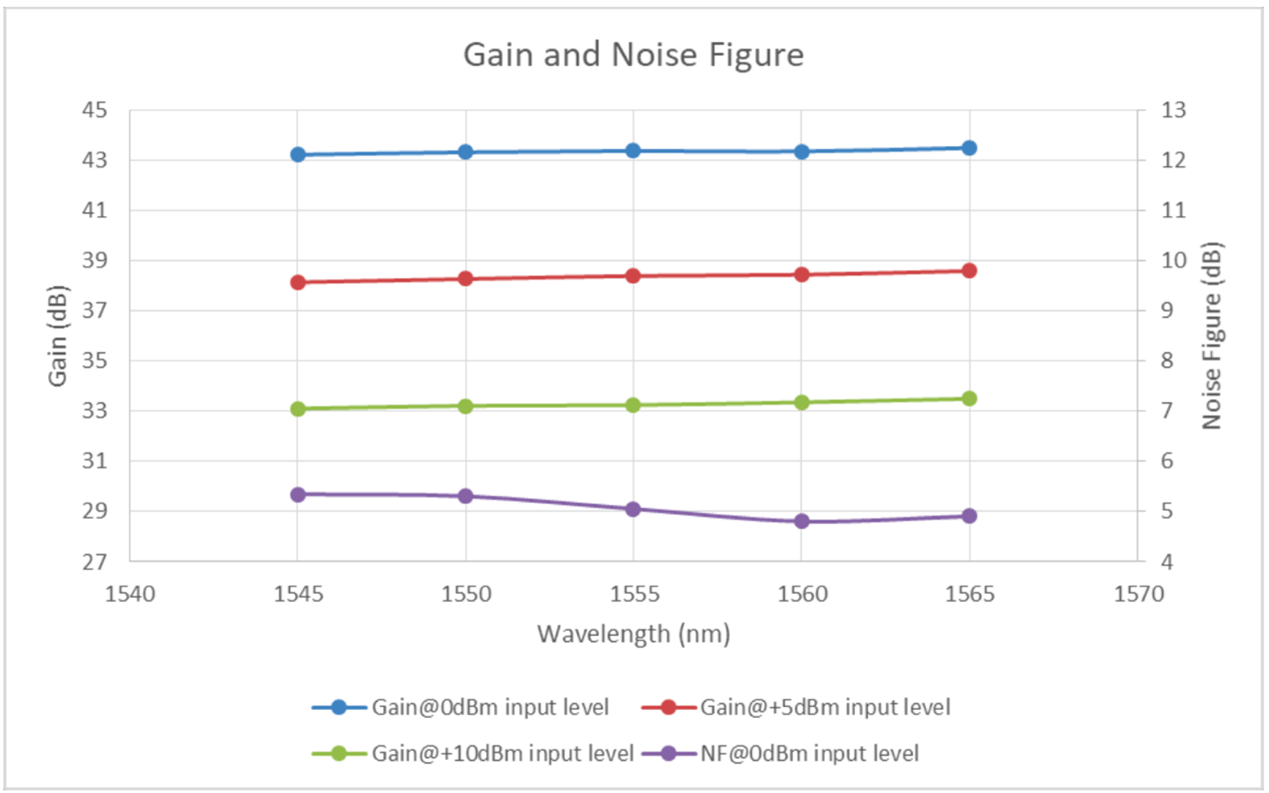
(2) Low, predictable noise figure
Especially important for coherent detection and DWDM multiplexing.
(3) Thermal and electrical robustness
Laser communication terminals often operate:
- Outdoors
- In vacuum
- Across extreme temperatures
(4) User-friendly controllability (RS232, Ethernet)
Integration with automated test setups is now mandatory.
(5) Turnkey operation (benchtop or rackmount)
Researchers require systems that work out-of-the-box with minimal setup.
5. Example Application: HP-EDFA for Hollow-Core Fiber Testing
Researchers commonly use:
- High Power EDFA/BDFA
- DWDM EDFA
Use cases include:
- Measuring attenuation over 10–100 km HCF spools
- Studying nonlinear behavior under high optical flux
- Validating multi-band wavelength transmission
- Building ultra-low latency testbeds for finance and data center R&D
These experiments drive the demand for reliable, thermally stable high-power EDFAs with clean spectral characteristics.
High-Power EDFA for Hollow-Core Fiber and Space Optical Systems
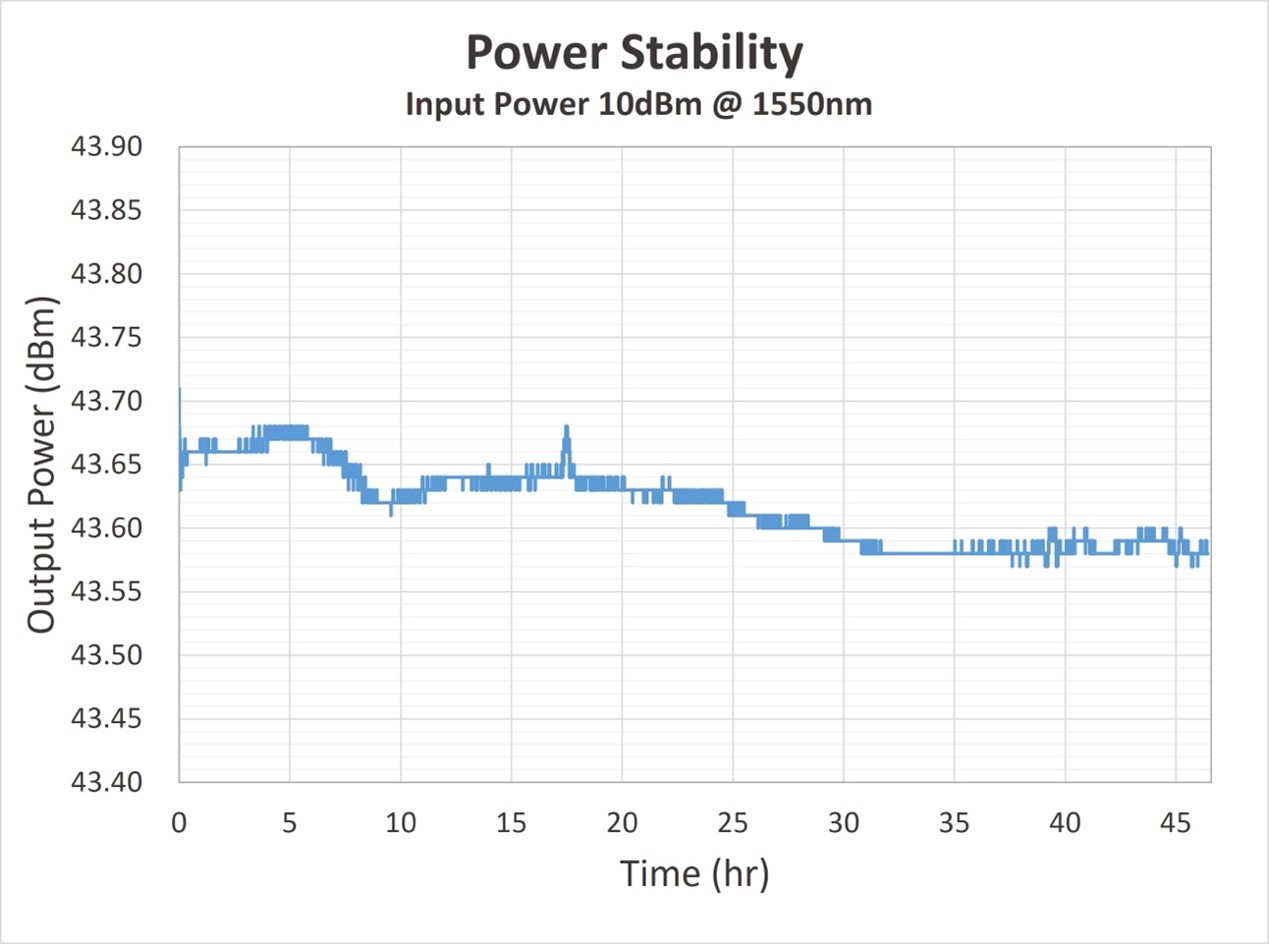
To support emerging research in hollow-core fiber transmission and space optical communication, high-power optical amplification must go beyond standard telecom specifications. Power stability, spectral cleanliness, and long-term reliability matter as much as headline output figures.
Our High Power EDFA series is designed specifically for these demanding environments.
The system offers saturated output power ranging from 0.5 W up to 20 W, covering the power levels commonly required for:
- Hollow-core fiber attenuation and nonlinear threshold testing
- Multi-wavelength DWDM transmission experiments
- Optical transmitter stages in space and free-space laser links
Rather than peak or burst-mode ratings, the output power specifications are defined under continuous-wave (CW), fully saturated operating conditions, ensuring reproducible and reliable test results.
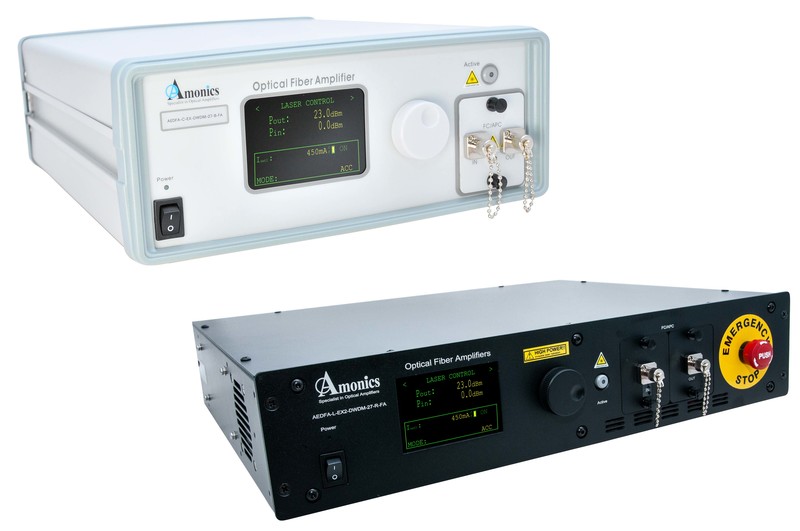
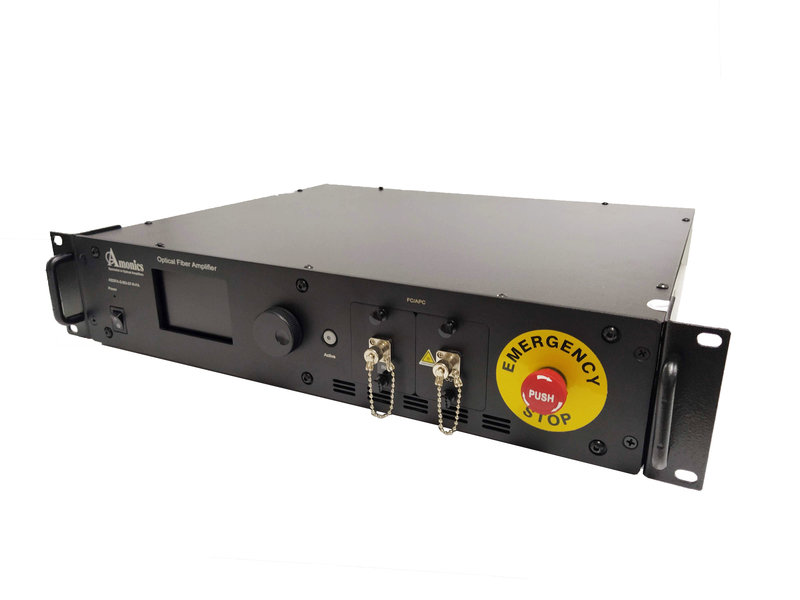
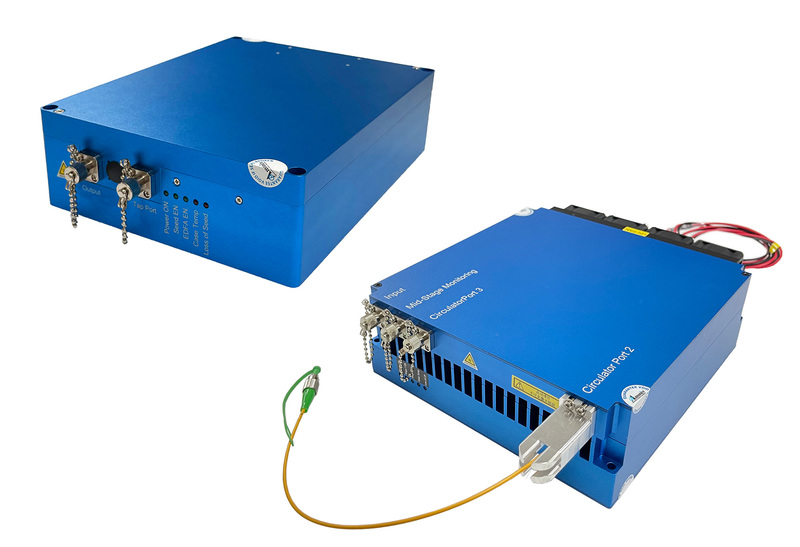
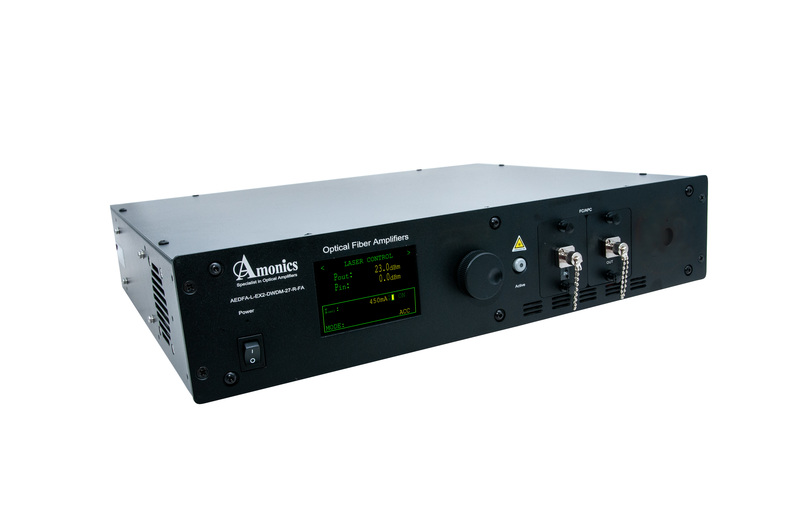
From a system perspective, the amplifier is delivered as a standalone turnkey unit, available in both benchtop and rackmount configurations, allowing immediate integration into laboratory setups or long-duration test platforms.
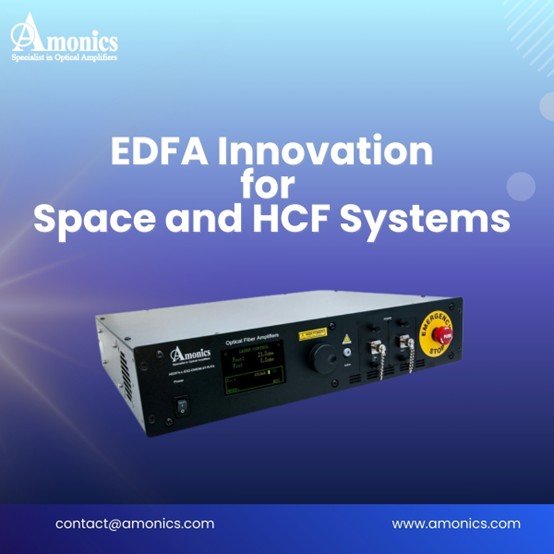
The front panel is designed for practical daily use, featuring:
- LCD display for real-time monitoring
- Optical power adjustment knob
- Key switch for operational safety
- Fiber input and output interfaces optimized for high-power handling
For automation and system-level control, a RS-232 interface is provided for remote monitoring, power control, and status diagnostics, enabling seamless integration into automated test benches and long-term experiments.
From an engineering standpoint, this high-power EDFA platform is widely used as a reliable optical power source in research environments where thermal stability, spectral integrity, and repeatable performance are critical—particularly in hollow-core fiber characterization and space optical communication research.
Power Stability
Gain & Noise Figure Performance
6. Looking Ahead: 2026–2030 Will Be the High-Power EDFA Decade
Combining research trends from Microsoft, BT, ESA, Euroconsult and leading universities, the next five years will see rapid growth in:
✓ Space optical communication
✓ Hollow-core fiber deployment
✓ Multi-band optical networks (O/E/S/C/L)
✓ AI data center interconnects
✓ Free-space optical sensing
In every scenario, high-power EDFA is a foundational component—much like the RF power amplifier was in the wireless era.
Optical networks are entering a power-hungry phase, and stable multi-watt amplification will be indispensable.
Final Thoughts
The industry is shifting toward broader spectrum utilization, higher optical power, and lower latency transmission—both on Earth and in space. High-power EDFA technology sits at the intersection of these developments.
Whether supporting hollow-core fiber research, powering laser communication terminals, or enabling next-generation DWDM, HP-EDFA has become a core building block of future optical systems.
As global demand for bandwidth and computational scale accelerates, high-power amplification will be one of the most important forces shaping optical communication in the coming decade.